October 24, 2026 · By Chris Floersch
The Ute That Keeps Travelling: A 1951 Ford "Twin Spinner" from Geelong
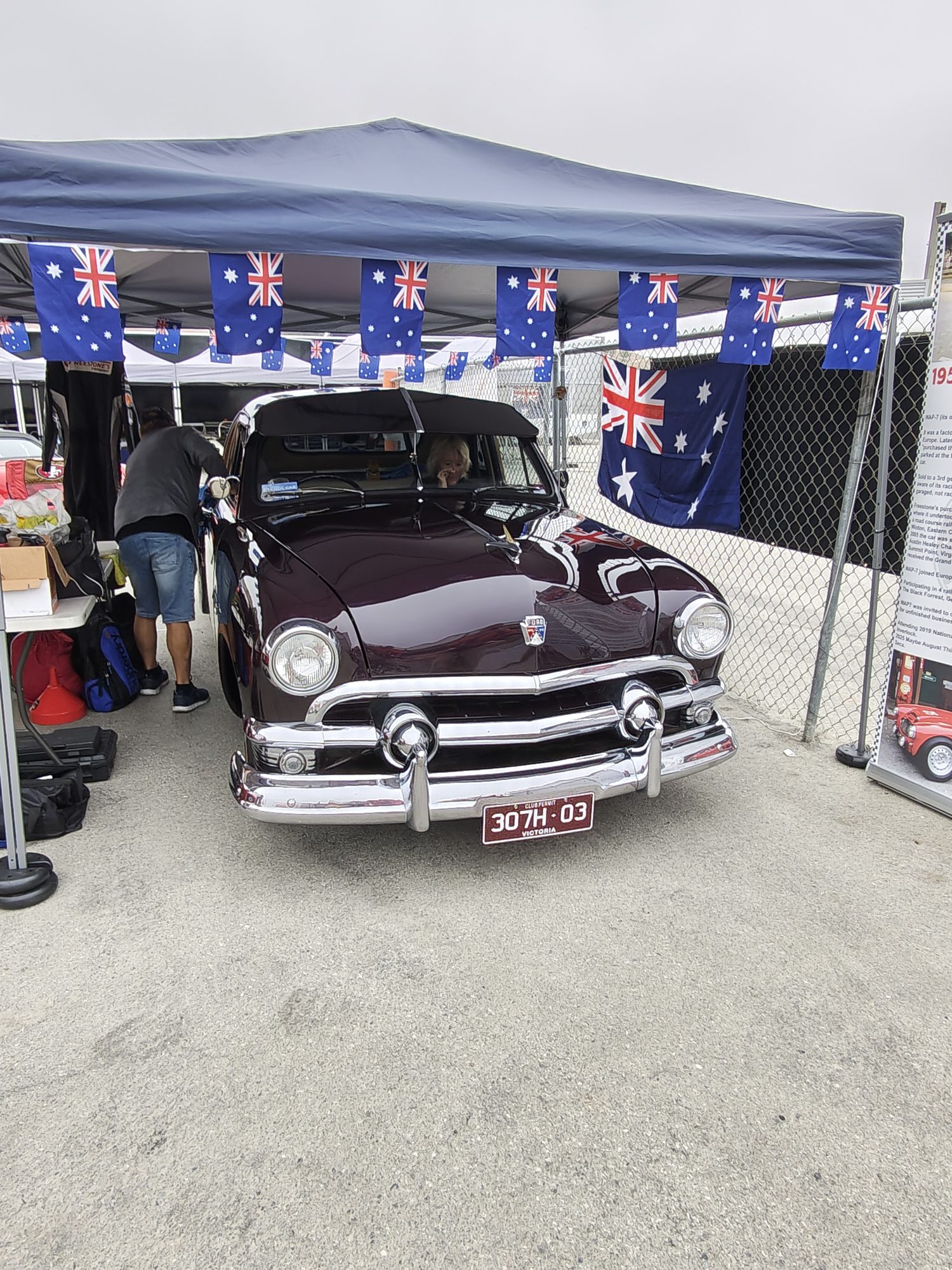
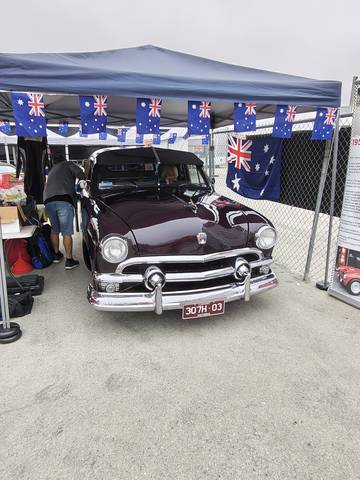
Tucked in among the race cars at Laguna Seca this August was a tent strung with Australian flags. Under it sat a car that had come a very long way to get there: a deep plum 1951 Ford with a mouthful of chrome and a maroon license plate from the state of Victoria. From the front it looks like an ordinary big American Ford. Walk around the side and you find out it isn't. Behind the cab, where a sedan would have a back seat and a trunk, there's an open cargo bed. It's a "ute."
"Ute" is short for "utility," and to Australians it means a car that's been turned into a small pickup: a car's comfortable front end and cabin, with a tray out the back. The ute was invented in Australia, and the story of how is one of the best in car history. In 1932 a farmer's wife in Victoria wrote a letter to Ford asking for a vehicle she could drive to church on Sunday that could also carry the pigs to market on Monday. A young Ford engineer named Lewis Bandt, working at the company's plant in Geelong, took the challenge. In 1934 Ford Australia released his answer, the coupe utility. When Henry Ford saw it in America, he nicknamed it the "Kangaroo Chaser." Ninety years later, utes are still a big part of Australian life.
For the gearheads: Bandt's key idea was structural, not just a car with the trunk cut off. He designed the cab and tray as one body, strong enough to carry real loads while keeping car comfort and handling. Bandt died in 1987 in a road accident while driving a 1934 ute he had restored, on his way home from filming a documentary about his invention. Ford Australia itself was founded in Geelong in 1925, so last year's centenary celebrations included the ute and Bandt's family.
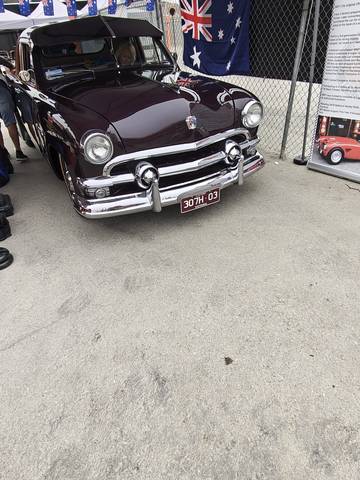
**Why "Twin Spinner"?** Look at the grille. There are two big chrome bullets sitting in it, one on each side. Fords from 1949 and 1950 had a single bullet in the middle, so enthusiasts call those "single spinners" and the 1951 cars "twin spinners." It's the quickest way to tell the years apart from across a parking lot.
For the gearheads: The 1951 Ford that Australia got was the Custom, assembled in Geelong with around 80 percent local content, including engine parts, gearbox, chassis and body panels. Australia had only the four-door sedan plus the locally designed coupe utility, which is why this ute is rare today. Power came from Ford's 239-cubic-inch (3.9-liter) flathead V8, rated at 100 horsepower and paired with a three-speed manual. "Flathead" means the valves sit in the engine block beside the cylinders rather than up in the cylinder head, so the head is just a flat lid. That design dates back to Ford's first V8 in 1932. The 1951 Ford also cost Australians over $1,200 when the brand-new Holden sold for about $900, so not many were sold.
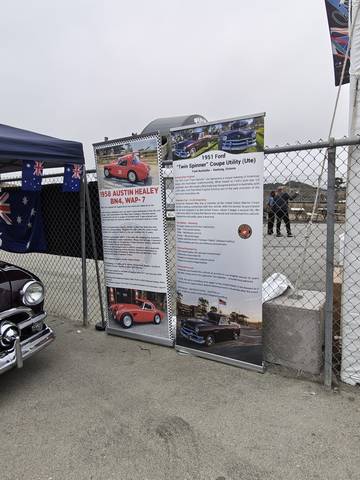
**A Marine's car.** The owners' display tells the rest of the story in their own words. During the Vietnam War era, a member of the United States Marine Corps "formed a lasting connection with this vehicle." After his service he bought the ute and shipped it to the United States, where it began a second life. He gave it an American makeover: a Chevrolet V8 in place of the Ford flathead, a custom paint color, and an interior trimmed in Napa leather. The family has tried hard to find out who that Marine was. As their banner puts it, "the trail sadly came a dead end." So somewhere out there is a Marine, or a Marine's family, who has no idea this car is back on the road.
For the gearheads: Swapping a flathead for a Chevy V8 was one of the most common American hot-rod moves of the 1960s and '70s. The Chevy small-block was lighter, made more power, and parts were everywhere. It's a little funny on a Ford, and a very American thing to do to an Australian car. The display doesn't say which Chevy engine is in it.
**Going home, and coming back.** About 20 years ago, an Australian family, the Freestones, found the ute at an auction in Los Angeles after a long search for a genuine Twin Spinner, and shipped it back to Australia. This year they shipped it across the Pacific again to enjoy as a cruising car at Laguna Seca, before it heads home after the event. It wears a maroon Victorian "Club Permit" plate. That's a special registration for historic cars in the state of Victoria that lets them be driven on the road on a limited number of days a year. The banner sums up the car's life in one line: "Australia – United States – Australia. A car, a Marine, a story that never stopped travelling."
**Its tent-mate.** Next to the ute stood a banner for the Freestones' other car, a 1958 Austin-Healey BN4 still known by its original British registration, WAP-7. It started out as a factory-prepared race car in the UK and Europe. Later, one owner bought it for "a couple of hundred quid" and turned it back into a road car. It then sat for about 15 years in a stamp collector's garage in New York State. The Freestones bought it in the early '90s, shipped it to Australia, fitted a full roll cage, and have raced and rallied it ever since: Targa Tasmania, Bathurst, the USA v Australia Austin-Healey Challenge (where, their banner says, Paul took the Grand Champion trophy), and European rallies from St. Moritz to Norway. If you read our post on Walt Sikes' Austin-Healey 100, WAP-7 is its bigger six-cylinder cousin. It's also another car in this family that won't stay on one side of the ocean.
Sources:
Photos